Public Backs The Junk Food Ban, But Says It Isn't Enough
05 Jan 2026
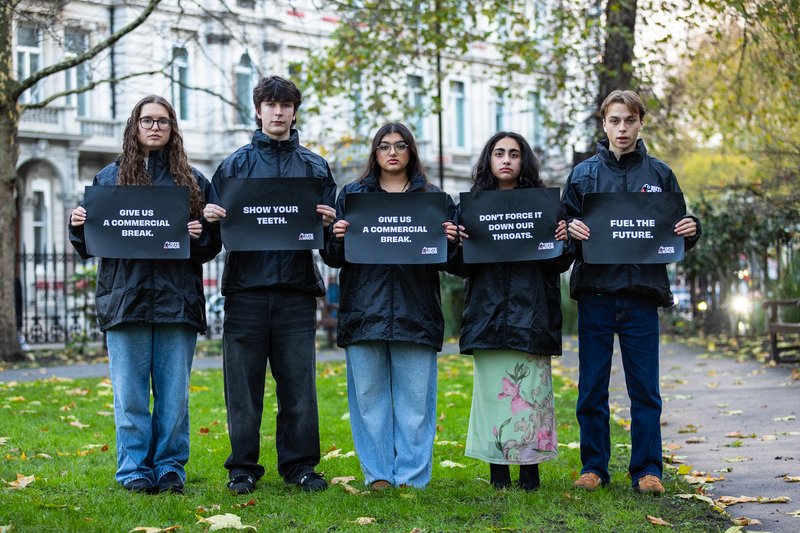
The January 5th junk food ad ban online, and on TV before 9pm has come into place, but Bite Back activists and public polling say it isn't enough.
Today (5 January 2026) marks an important moment for children’s health. New restrictions on junk food advertising on TV before 9pm and online have finally come into force across the UK, following years of campaigning by young people and parents.
To coincide with the new rules — known across the Bite Back movement as #JanBan — the charity has published new polling with the agency, More in Common, showing strong public support for action to protect children from junk food advertising. The survey found that two in three adults think it is unacceptable to target children with junk food ads, and more than half want the ban extended to outdoor advertising such as billboards, bus stops and digital screens near schools.
Young people across Bite Back have welcomed the change, while being clear that it must be the start, not the end.
Edda, a Bite Back activist, said:
“I feel that #JanBan is more than necessary — it’s a crucial step in protecting children’s health. Since moving from secondary school to college, I’ve been less sheltered and able to go out at lunch and break times, and I didn’t realise just how many junk food adverts there are on billboards, buses and everywhere else. The reality is that one in three children are at risk of food-related illness in the future, yet the only food-related things we see are adverts for junk food. Getting rid of these ads online and on TV before the watershed is the least we can do. We need to stop junk food being in the spotlight and put children’s health at the forefront of our decisions.”

For Edda, the priority now must be putting children’s health ahead of junk food being constantly in the spotlight.
Prusha said #JanBan shows what’s possible when young voices are listened to.
“I’m genuinely happy this ban is finally coming into place because young people have been fighting for years to be protected from constant junk food advertising. It proves that change is possible when our voices are listened to, and it’s an important step for children’s health when they’re under so much unfair pressure from powerful brands. But it doesn’t go far enough — if ads are removed from our screens, they’ll just be pushed onto our streets unless the government closes the loopholes,” Prusha quipped.

Another activist, Jomi, said with so many children leaving primary school at risk of food-related illness, adding that the remaining loopholes make it clear this cannot be the end of the story.
Alongside Farid, Alice, Jayda and others, Bite Back activists have also been speaking out publicly about how junk food advertising shapes the environments young people grow up in, from public transport to high streets.
D’Arcy Williams, Chief Executive of Bite Back, said: “Today is a big day for food policy and, most importantly, for children’s health. The long-delayed and now diluted restrictions on junk food advertising are finally coming into force. But young people and the public are clear that the government must go further.
“At a time when one in three children leaves primary school at risk of food-related ill-health, implementing these regulations is a welcome move from a government that has committed to raising the healthiest generation ever. However, this cannot be the end of the story. Closing advertising loopholes and following through on wider food policy – including the introduction of Healthy Food Standards – will be essential if children are to grow up in healthier environments. Young people have been loud and clear: we cannot stop here.”
The public agrees. Bite Back’s polling shows more people think the government is doing too little to protect children’s health than believe it is doing enough, and most think children’s needs should come before the interests of food companies.
The new rules are a step forward. But young people are clear: to truly protect children’s health, the government must go further and close the loopholes that still allow junk food advertising to dominate everyday life.
We’re calling on readers, policymakers and the public to back our Bite Back campaign and stand with young people demanding a fairer food system.
For more information, interview opportunities and photography: Henry Makiwa (henry.makiwa@biteback2030.com / 07523681057)
More in Common polling for Bite Back saw 2,108 GB British Adults surveyed, across 13 — 16th December 2025. Full survey results available upon request.

Sign up!
NIHR (2024). Children’s exposure to high fat, sugar and salt food and drink advertising and response to brand advertising: a robust and comprehensive baseline assessment and qualitative exploration.
Food Foundation (2025) The State of the Nation's Food Industry report 2025 [online] Available here.
Jenneson VL, Wilson I, Pontin FL, Evans CEL, Morris MA. Mapping Advertising Assets Project: a cross-sectional analysis of food-related outdoor advertising and the relationship with deprivation in Leeds, UK. Public Health Nutr. 2025 Sep 3;28(1):e161. doi: 10.1017/S1368980025100670. PMID: 40899156; PMCID: PMC12516639.
Bite Back (2024) Fuel Us Don’t Fool Us [online]. Read our report here.